Records continue – report on the warehouse market after H1 2021
In the second quarter of 2020, the COVID 19 pandemic hit the indicators of practically the entire economy. The warehouse sector was one of the few that not only withstood the crisis but even recorded growth incomparable to previous years. Although a year and a half has passed since then, the demand for warehouse space is not decreasing, and for now, there is no indication that a slowdown will occur in the near future.
Almost 22 million sqm of warehouse space
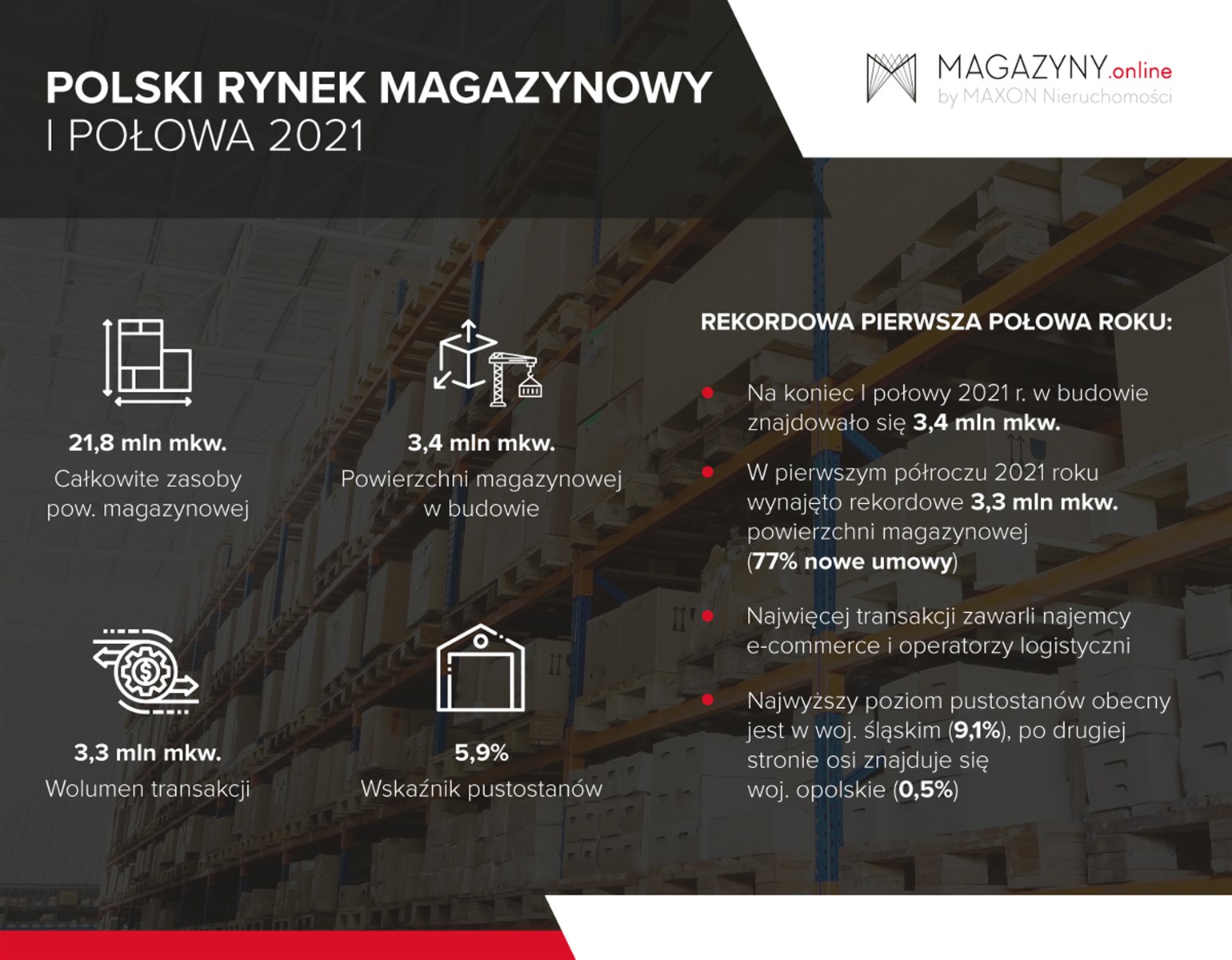
After the first half of 2021, there is a total of over 21.8 million sqm of modern warehouse space in the country. Consistently, the largest centers in Poland remain the Masovian Voivodeship with almost 5 million sqm of space, the second in the ranking is the Silesian Voivodeship with over 3.8 million sqm, and the podium is closed by the Łódź Voivodeship with 3.3 million. The fourth place belongs to the Greater Poland Voivodeship, where space resources already amount to 2.6 million sqm. At the same time, the Greater Poland Voivodeship is the region where lease agreements for over 660 thousand sqm were signed in the first half of 2021 (the best result in the country).
A huge construction site and new players on the market
Despite problems with availability and rising prices of building materials, a record 3.4 million sqm of new warehouse space remains under construction. This means that by the end of 2022, the barrier of 25 million sqm of existing space will be exceeded.
The largest projects currently being implemented are:
- Panattoni BTS Świebodzin: 203 thousand sqm.
- Panattoni Central European Logistics Hub: 179 thousand sqm.
- Hillwood Rokitno: 112 thousand sqm.
- Panattoni BTS Poznań: 107 thousand sqm.
- Hillwood Bydgoszcz: 102 thousand sqm.
In the last half-year, the appearance of new warehouse developers on the Polish market can be observed.
Unabated interest from tenants
In the first half of 2021, lease agreements for 3.3 million sqm of space were signed. Over 2.5 million sqm consisted of new agreements (77%). The largest lease transactions in the first half of the year are:
- Panattoni BTS Poznań: 109 thousand sqm.
- P3 Poznań II: 82 thousand sqm.
- Panattoni BTS Gorzyczki: 82 thousand sqm.
- Panattoni Wrocław Campus: 78 thousand sqm.
- Hillwood Rokitno: 78 thousand sqm.
Optimistic forecasts
At the moment, there is no indication that the Polish warehouse market is facing a slowdown. Neither problems with the availability of general contractors nor rising material prices affect tenant interest. Taking into account the impact of the pandemic on the warehouse market so far, as well as the development plans of companies from the e-commerce and logistics industries, results at unchanged levels can be expected in the next half-year.