The end of unlimited fire zones. The new Technical Conditions have reached the Legal Commission — what lies ahead for the warehouse market
The draft of the new regulation on the technical conditions to be met by buildings and their location, and on the technical conditions for the use of residential buildings, has just been sent to the Legal Commission of the Government Legislation Centre (RCL). This is the penultimate substantive stage of the work — all that remains is notification to the European Commission, the minister's signature and publication. For the warehouse industry, this means one thing: the era of designing halls with unlimited fire zones is coming to an end, and the clock is ticking for projects carried out under the old rules.
Where we are: the status of work on the new Technical Conditions
The draft of the new regulation — which will replace the Technical Conditions in force since 2002 and amended many times — was published on the Government Legislation Centre website in June 2025. Since then, it has gone through the full process: public consultations and opinions, for which it was sent to nearly two hundred entities in total — from the National Headquarters of the State Fire Service (PSP), through the chambers of architects and civil engineers, to organisations of building materials manufacturers. Inter-ministerial arrangements concluded with a reconciliation conference on 20 April 2026 — after additional explanations from the ministry, no ministry upheld its comments. On 16 June 2026, the draft received a positive opinion from the Joint Commission of the Government and Local Government, and on 14 July 2026 it was referred to the RCL Legal Commission, which is finalising the wording of the text (item 29 of the MFiG list of legislative work, continuing the process begun under item 68 of the MRiT list).
It is worth emphasising something often overlooked in industry discussions: the regulation will not go to the Sejm. It is an implementing act issued unilaterally by the minister responsible for construction (currently, following changes in the government structure, the Minister of Finance and Economy) on the basis of the delegation in Article 7 of the Construction Law. There will be no vote, no parliamentary amendments and no presidential veto. The window for substantive changes has in practice already closed — and what the industry fought for at the consultation stage can be seen in the final text.
The core of the change: the end of § 230, i.e. the unlimited sprinklered zone
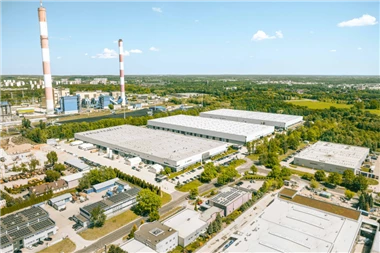
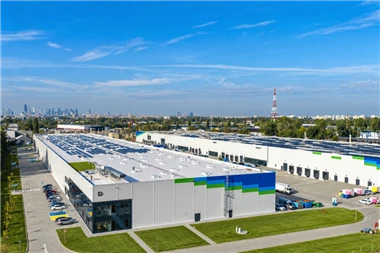
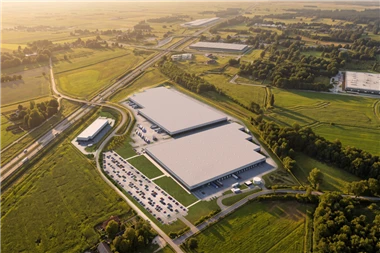
Current regulations allow a fire zone of unlimited size in a single-storey PM (production and storage) building, provided that fixed automatic water extinguishing systems and automatic smoke exhaust systems are installed. The entire Polish large-scale logistics sector is based on this provision — big-box warehouses with zones of 30, 40 or even 60,000 m² in a single sprinkler-protected zone.
The new draft abolishes this option — and does so entirely deliberately. In its justification, the ministry states plainly that the existing allowance does not fulfil the basic fire safety requirement of limiting the spread of fire and smoke, and that zones unlimited in area create a risk of „large-scale damage” when the safety of the whole building depends on the reliability of a single fire protection device. The existing rule is being replaced by a tabular system: a base permissible zone area depending on fire load density, which can be increased by specified percentages for individual safety measures.
For a single-storey hall, the increases are:
- sprinklers with a single water supply — by 200%,
- sprinklers with a dual water supply — by 300%,
- automatic smoke exhaust systems — by 100%,
- a fire alarm system with monitoring connected to the State Fire Service — by 50%.
Importantly, the version sent to the Legal Commission includes additional increases that were absent from earlier versions of the draft — a clear sign of the industry's successful lobbying. A hall built of non-combustible elements (reaction-to-fire class A1 or A2,d0) can be increased by an additional 100%, and if it is up to 17 m high and has fire access roads on two opposite sides (no point of the roof further than 40 m from the wall along the fire access road) — by a further 200%.
How large will the maximum zone realistically be?
Adding up all the increases (sprinklers with dual supply + smoke exhaust + fire alarm system with monitoring + non-combustible structure with fire access roads on two sides), the base area can be multiplied by a maximum of 7.5. In practice, this gives:
| Fire load density Q | Base area | Maximum zone (full package of safety measures) |
| Q > 4000 MJ/m² | 2,000 m² | approx. 15,000 m² |
| 2000 < Q ≤ 4000 MJ/m² | 4,000 m² | approx. 30,000 m² |
| 1000 < Q ≤ 2000 MJ/m² | 6,000 m² | approx. 45,000 m² |
There are two conclusions. First, the declaration of Q > 4000 MJ/m² typical of the leasing market — adopted so as not to restrict tenants in terms of the type and height of storage — will become very costly: a limit of approx. 15,000 m² means that a 50,000 m² hall will need to be divided into 4 zones by fire separation walls. Second, designing with a lower, documented fire load (Q ≤ 2000) will make it possible to keep zones of up to approx. 45,000 m² — but at the expense of the building's commercial flexibility. In addition, zones above 30,000 m² will require building elements to be made exclusively of non-combustible products.
A separate cost will be the dual water supply for the sprinkler system itself (the difference between +200% and +300%) — in practice, an expanded pump house and an additional tank reserve.
What about existing halls? Three risk scenarios
The principle of non-retroactivity remains fundamental: an existing, lawfully used warehouse does not have to be adapted to the new regulations simply because the law has changed. However, the draft provides for three situations in which the new requirements may reach an existing building:
1. Extension, adding storeys, reconstruction or change of use. The new regulations apply to the part covered by the works — and the draft contains an explicit provision (§ 217(7)) resolving previous interpretative disputes. The new requirements extend to the remaining parts of the building only when this is necessary to meet the requirements in the extended part, or when the fire zone covering that part contains conditions qualifying the building as endangering human life. In practice: adding an office building as a separate fire zone, separated from the hall, will not entail an obligation to divide the existing warehouse zone. But incorporating a new part into an existing zone — for example an open mezzanine — means the enlarged zone is assessed against the new, much stricter limits. For zones of several tens of thousands of square metres, this route will be practically closed, leaving only the path of a technical expert opinion and alternative solutions agreed with the provincial commander of the State Fire Service.
2. A building deemed to endanger human life. The fire safety provisions of the new regulation also apply to existing buildings in use that have been classified as such under fire protection regulations — regardless of any construction works.
3. Amendment of a building permit. Beware of a less obvious case: an application to amend a building permit submitted after the new regulations come into force may open a discussion on the extent to which they apply to the project. For projects under way that involve significant departures from the approved design, it is worth closing the formalities before the cut-off date.
Deadlines and time windows: a calendar for investors
The draft provides for entry into force on 20 September 2026 — with only the provisions on mandatory use of solar energy (§ 358(2)–(4)) deferred, coming into force on 31 December 2026 and 31 December 2029. All fire safety provisions will apply from the main date.
There is, however, one significant unknown: European notification. The regulation contains technical rules and must be notified to the European Commission under Directive 2015/1535, which triggers a standstill period of at least three months during which the act cannot be adopted. As of July 2026, notification had not yet taken place. If the EC or another Member State issues a detailed opinion, this period will be extended, and the 20 September 2026 date may become unrealistic and be postponed. Monitoring this stage is currently the most important watch point for the entire industry.
Key for investors, however, is the transitional rule (§ 394 of the draft): which regulations apply to a project is determined by the situation before the date of entry into force — a submitted building permit application, an application to amend a permit, a filed notification, an issued decision. An application submitted before the date of entry into force means the entire case proceeds under the existing, more lenient regulations. Interestingly, the draft also provides a loophole in the other direction: an investor may voluntarily apply for the new regulations to be used — which may make sense where the new rules liberalise something.
Practical recommendations for today:
- Projects in preparation — if the concept assumes zones above the new limits, the priority is to submit a complete building permit application before the date of entry into force. The realistic window is at least until 20 September 2026, with a possible bonus if notification delays the act.
- Planned extensions of existing buildings — similarly: an application submitted before the cut-off date closes the matter. After that — design extensions only as separate fire zones with full separation.
- Existing buildings with no investment plans — no obligation to adapt, but it is worth verifying the fire safety status of the building (to rule out the risk of being classified as endangering human life) and putting in order the documentation of derogations and alternative solutions.
- New projects after the change in regulations — the decision on the declared fire load density will become one of the most important business decisions of a project: a trade-off between zone size, the cost of fire separation walls, the cost of dual sprinkler supply and leasing flexibility.
Summary
The new Technical Conditions are the most profound change to the design rules for warehouse buildings in two decades. The ministry itself admits in its regulatory impact assessment that the fire safety changes will be felt primarily in large-scale retail, production and warehouse buildings. The version sent to the Legal Commission is more lenient than the original draft — the additional increases for non-combustible construction and fire access roads genuinely raise the limits — but the direction is unambiguous: the end of unlimited zones, a return to fire load calculations and rewarding buildings with a full package of safety measures. For developers and investors, the coming weeks are the time to audit their project pipeline and decide what must be filed with the authorities before the date of entry into force.
This article is for information purposes only and is based on the documentation of the draft regulation sent to the RCL Legal Commission (July 2026): the text of the draft, the justification and the regulatory impact assessment. The final content of the act may change before publication in the Journal of Laws. This text does not constitute legal advice — investment decisions should be consulted with a fire safety expert and a lawyer.